Van Shanghai Shenghua de Kabel (Groep) Co., Ltd.
THHN, THW, THWN, H07V-K and BV all describe a single core PVC insulated wire, yet they are not interchangeable, and confusing them is one of the most common causes of a rejected shipment. The letters encode insulation material, temperature rating, jacket presence, conductor class and the standard system the wire belongs to. This guide decodes the North American THHN, THW and THWN family, places it beside the European H07V series and the Chinese BV and BVR types, explains where the requirements genuinely diverge, and shows how to specify the right one for a project. It closes with six answers on ampacity, jacket requirements, wet locations and cross-market substitution.

The North American designations are built from letter groups, each carrying a meaning. T stands for thermoplastic insulation. H indicates a heat resistant compound rated 75 degrees Celsius in dry conditions. HH raises that to 90 degrees. W means the wire is suitable for wet locations. N indicates a nylon jacket over the insulation. Reading the string in order gives the full product: THHN is a thermoplastic, high heat, 90 degree, nylon jacketed wire for dry and damp locations; THWN adds wet location suitability; THW is a thermoplastic heat resistant wire for wet locations without the nylon jacket.
The European H07V family works differently. H07V-U has a solid conductor, H07V-R a stranded conductor, and H07V-K a fine stranded flexible conductor. All three are rated 450/750 volts and 70 degrees Celsius, and they are harmonised across the EU, which means a wire made to the harmonised document is accepted in every member state without separate national approval.
The Chinese BV and BVR types are the domestic equivalents: BV with a rigid conductor and BVR with a flexible stranded conductor, both PVC insulated, commonly 450/750 volts. They look identical to an untrained eye and differ in conductor stranding, bendability and the standard under which they are tested.
| Code | Insulation | Temperature | Conductor | Typical market |
|---|---|---|---|---|
| THHN | PVC with nylon jacket | 90 C dry | Stranded or solid | North America |
| THWN | PVC with nylon jacket | 75 C wet / 90 C dry | Stranded | North America |
| THW | PVC, no jacket | 75 C | Stranded | North America |
| H07V-U | PVC | 70 C | Solid | EU harmonised |
| H07V-R | PVC | 70 C | Stranded | EU harmonised |
| H07V-K | PVC | 70 C | Fine stranded | EU harmonised |
| BV / BVR | PVC | 70 C | Solid / stranded | China, Asia, Africa |
The temperature rating is not a marketing number. A THHN conductor may run at 90 degrees Celsius in dry conditions, which allows a higher ampacity for the same cross section, or a smaller cross section for the same current. A 70 degree H07V-K must be derated, and a designer who substitutes one for the other without recalculating will either oversize the cable or overload it. In a conduit packed with conductors, the difference between 70 and 90 degree insulation is often the difference between a compliant installation and one that fails inspection.
The nylon jacket on THHN and THWN is a second real difference. It provides abrasion resistance during pulling, reduces friction in conduit, and gives additional protection against gasoline and oil. A H07V-K has no such jacket, so it is more vulnerable in a long conduit pull or in a machine tool exposed to cutting fluid. Substituting the European wire for the American one in a US project is therefore not a labelling exercise: the physical construction differs.
The third difference is the approval system. A North American project will require UL listing to the relevant standard, and an inspector will look for the listing mark on the product or the packaging. A European project will require a declaration of conformity to the harmonised document. A supplier who can produce one but not the other cannot serve both markets from one stock line, and a buyer who assumes otherwise discovers it at the port.
Finally, conductor stranding affects installation. Solid wire is cheaper and terminates well in screw terminals, but it is stiff and unsuitable for panel wiring with tight bends. Fine stranded wire is flexible and preferred for machine and panel work, but it requires ferrules or suitable terminals to avoid strand damage. Choosing the wrong class leads to rework on site, which costs far more than the wire.
Buyers comparing PVC insulated single core products across these families should look at the actual constructions, for example the Low Voltage XLPE Insulated Power Cable With Nature Color XLPE Insulation BV / CE and the shanghai shenghua power cable 1.5sq mm 2.5sq mm Single Core Electrical Cable Wire For Fixed Wiring H05V-K H07V, and confirm which standard system the factory tests to before assuming equivalence.
Start from the installation, not from the code. Identify whether the location is dry, damp or wet; whether the wire runs in conduit, tray or free air; whether it will be pulled through long runs; and what temperature the conductor will reach under load. Those four answers determine the family, and only then does the code follow.
Then state the standard and the approval in the purchase order, not just the code letters. A line that reads THHN 12 AWG stranded copper, UL 83 listed, 600 V, 90 C dry, on 500 foot coils is unambiguous. A line that reads PVC wire 4 mm2 is not, and it invites a supplier to ship whatever is closest to hand.
Ask for the conductor class explicitly. Class B stranded, class C, class K and class 5 fine stranded all exist, and each has a different use. For panel and equipment wiring, fine stranded with ferrules is usually right; for building conduit work, class B or a solid conductor is normal. State the class and the number of strands per conductor.
Verify on receipt rather than on trust. Check the print on the wire against the purchase order, confirm the conductor diameter or strand count, measure the insulation thickness at a cut end, and confirm the approval mark. Retain a one metre sample per batch. Where the same wire is bought repeatedly, compare each delivery against the retained sample: a thinner wall or a different surface finish is usually the first visible sign of a compound change.
For cross-market projects, keep a substitution table approved by the designer in advance. A table that maps THHN to H07V-K to BV, with the temperature and jacket differences noted, saves an argument later and prevents an unapproved substitution on site. The substitution should always be documented, never assumed by the purchasing team.
Finally, plan the packaging around the installation. Coils of 100 metres suit domestic and small commercial work; 500 metre or 1000 metre reels suit contractors pulling long runs; and short lengths in multiple colours suit panel shops. Products such as the Copper Wire Screen Aluminum Conductor XLPE Insulated Power Cable For Power Distribution 12KV and the Single Core 185mm 2 outdoor armoured electrical cable 33KV Rated Voltage are typically supplied in coil form, while larger building wire orders ship on returnable reels. Matching packing to the job reduces waste and site handling.
The published thickness values in a standard are nominal, and the tolerance below the nominal is small but real. A wire built at nominal thickness has a defined dielectric margin; one built at the lower limit has less, and while both pass the routine voltage test, they do not behave identically in a hot conduit or after years of thermal cycling. When a specification matters, the buyer should ask for nominal thickness rather than relying on the code, because the code alone does not fix the value.
For THHN and THWN the nylon jacket adds a second layer whose thickness is also specified. A jacket that is too thin offers little abrasion protection and wears through during a long pull; a jacket that is too thick stiffens the wire and can crack when bent sharply at a cold temperature. The practical check is a bend test on a short sample: fold the wire around a mandrel of the recommended diameter at the lowest expected site temperature and inspect the jacket for crazing.
A 90 degree rating assumes the conductor actually reaches that temperature without the insulation being damaged by the installation. Pulling a wire around a tight corner can crush the insulation, and the damage is invisible from outside. Respecting the minimum bend radius, using pulling lubricant compatible with PVC, and avoiding sharp conduit entries are what keep the rating meaningful.
Terminations matter as much as the wire. A fine stranded conductor needs a ferrule or a terminal rated for that class; a solid conductor needs a terminal that does not cut the strands when the screw is tightened. Where aluminium is involved, the connector must be rated for aluminium and, in damp locations, used with the appropriate compound. Most failures attributed to wire quality are in fact termination failures, and they are preventable with a small amount of training.
Projects funded internationally often carry two specification systems at once: a local code for the installation and a lender or consultant standard for the equipment. The result is a bill of quantities that mixes THHN for the mechanical packages with H07V-K for the building services, and a supplier who can only offer one family will lose half the order or invite substitutions that the consultant rejects.
The practical answer is a quotation that separates the two families and states the standard, the conductor class and the approval for each line. It costs nothing to structure a quote that way, and it turns a confusing enquiry into two clear decisions. Where a substitution is proposed, it should be marked as such rather than presented as the specified item, so the buyer can approve it consciously.
Warehouse and logistics planning also differ. THHN is normally supplied on reels of several hundred feet or metres, while H07V-K arrives on coils of one hundred metres in multiple colours. Mixing the two on one shipment means two packing schemes, two sets of labels and two receiving processes on site. Knowing that in advance keeps the delivery from becoming a handling problem.
Only with written approval. H07V-K has no nylon jacket and a 70 degree rating, so both abrasion resistance and ampacity differ. An engineer must confirm the substitution.
The 90 degree dry rating permits a higher conductor temperature, which raises the permissible current. Building wire ampacity tables reflect that difference.
It improves abrasion resistance and reduces friction in conduit, and some North American specifications require it. In dry, short runs it is not always essential, but it is part of the THHN definition.
BV has a rigid solid or coarse stranded conductor; BVR has a flexible stranded conductor. Both are PVC insulated, but BVR bends more easily and costs slightly more.
Rarely from one production line, because the temperature rating, jacket and approval differ. A factory can build both, but they must be ordered and marked separately.
Count and measure the strands at a cut end and compare with the class table for that size. A shortfall in strand count indicates a cheaper construction.
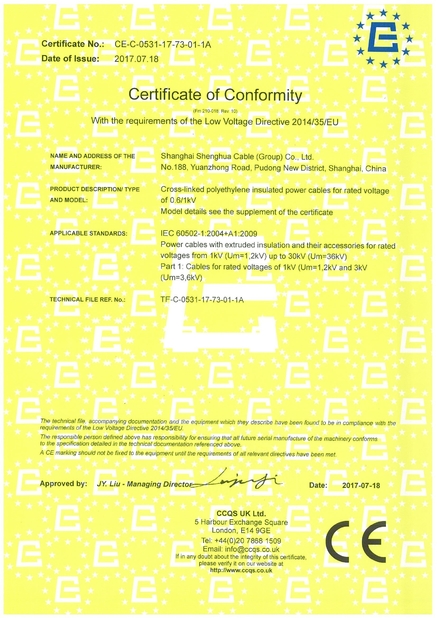
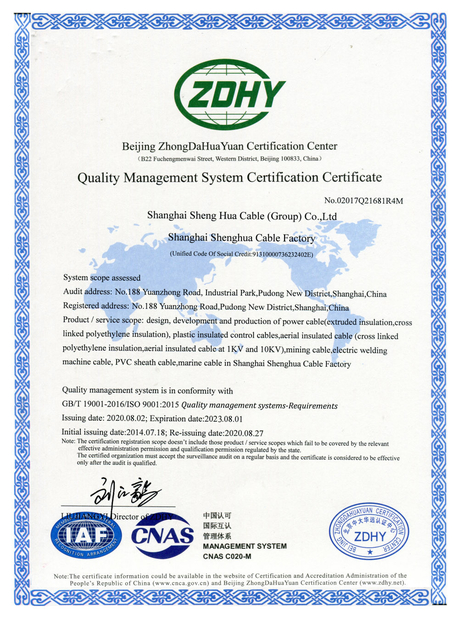
THHN, THW, THWN, H07V-K and BV describe different products with different temperatures, jackets, conductor classes and approval systems. Treating them as interchangeable is a procurement risk that surfaces at inspection, not at quotation. Specify the code together with the standard, the approval, the conductor class and the packing, and verify the print and the construction on arrival. Shanghai Shenghua Cable Group produces PVC insulated single core wire in THHN, THW, H07V and BV constructions with the relevant test data and approval documentation for each market, and it will state the conductor class and temperature rating on the quotation. Send your wire schedule through our contact page and our engineers will map each line to the correct construction. Related products include the Shenghua Group Power Cable NYY NYCY Electrical Fire Resistant Cable For Buidings / House Wiring, the N2XY 1x120mm2 Single Core High Purity Copper PVC Insulated Power Cable 0.6/1kV Distribution, the PVC Type ST5 Sheath Electrical Cable Wire Copper Core 500v BV Sh Shenghua and the shanghai shenghua cable 450V 750V Low Smoke Zero Halogen Wire , Copper Building Wire 2 Years Warranty.